Solving Binary Tree Maximum Path Sum: Finding the Highest Valued Path
The "Binary Tree Maximum Path Sum" problem involves finding a path in a binary tree that produces the highest sum of values. The path may start and end at any node in the tree and can traverse up or down through the tree.
Problem Statement
Given a non-empty binary tree, find the maximum path sum. The path must contain at least one node and does not need to go through the root.
Example
Consider a binary tree:
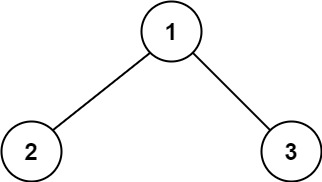
Input:
Output:
Explanation: The optimal path is 2 -> 1 -> 3 with a path sum of 2 + 1 + 3 = 6.
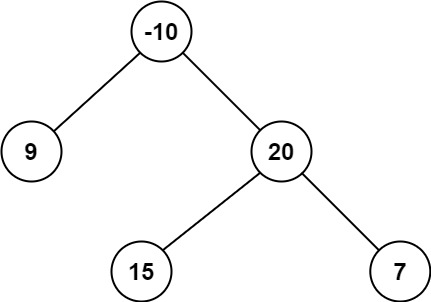 Input:
Output:
Explanation: The optimal path is 15 -> 20 -> 7 with a path sum of 15 + 20 + 7 = 42.
Solution Approach - Recursive Depth-First Search
Breaking Down the Solution
- Recursive Function: The
maxGainfunction calculates the maximum sum starting from each node. - Path Sum Calculation: At each node, calculate the maximum sum of any path that includes the node.
- Global Maximum: Track the maximum path sum found in the entire tree.
Conclusion
The Binary Tree Maximum Path Sum problem is a complex and intriguing challenge, showcasing the depth and flexibility of recursive algorithms in tree data structures.
Rust Solution
Option<Box<TreeNode>> gives each child either None or a heap-Boxed node, which is required because a directly self-referential struct has no compile-time size. Rather than the TS closure that captures maxSum, the running best is threaded through as a &mut i32 argument, and each frame updates it via *max_sum = (*max_sum).max(new_path). The match splits the base case (None => 0) from Some(n), and n.left.as_ref() turns the owned Option<Box<TreeNode>> into an Option<&Box<TreeNode>> so the recursion borrows each child instead of moving the tree out of its owner.
Go Solution
Children are plain *TreeNode pointers, so an absent child is nil and the base case is if node == nil { return 0 }. Instead of a closure, the running best lives in the package-level var maxSum int, seeded to -1 << 31 (the minimum 32-bit int) at the top of maxPathSum. The newTreeNode constructor returns a &TreeNode{val: val} composite literal, leaving left and right at their nil zero value, and a hand-rolled max(a, b int) supplies the two-way comparison.
Comments (0)
Stub — comments live in your browser only (localStorage). No server round-trip yet.
No comments yet. Be the first.