Solving Binary Tree Level Order Traversal: Navigating Trees by Level
The "Binary Tree Level Order Traversal" problem involves traversing a binary tree level by level, collecting nodes at each level in separate lists.
Problem Statement
Given the root of a binary tree, return the level order traversal of its nodes' values. (i.e., from left to right, level by level).
Example
Consider a binary tree:
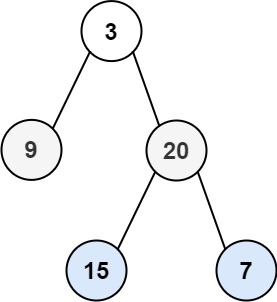
Level order traversal of this tree is [[3], [9,20], [15,7]].
Solution Approach - Queue-Based Traversal
Breaking Down the Solution
- Queue Mechanism: Use a queue to keep track of nodes at each level.
- Iterative Traversal: Iteratively process nodes in the queue, adding their children to the queue for the next level.
- Collecting Levels: Collect the values of nodes at each level in separate lists.
Conclusion
Binary Tree Level Order Traversal is a fundamental problem in tree algorithms, emphasizing breadth-first traversal and demonstrating the practical use of queues in managing hierarchical data structures.
Rust Solution
Rust encodes a nullable child as Option<Box<TreeNode>> — the Box puts each node on the heap so the recursive struct has a known size, and None stands in for JS's null. The queue is a VecDeque<&TreeNode> of borrowed references, so nodes are never moved out of the tree: node.left.as_ref() turns the Option<Box<TreeNode>> into an Option<&Box<..>> that if let Some(l) can match without taking ownership, and l.as_ref() narrows the Box down to the &TreeNode the queue actually stores. The for _ in 0..n loop discards its counter with _ because only the level's node count matters, and each pop_front().unwrap() is safe since n bounds the loop to exactly the nodes already queued.
Go Solution
Go uses a plain slice []*TreeNode as the queue: queue = append(queue, ...) enqueues a child and queue = queue[1:] dequeues by reslicing past the head rather than shifting elements. Children are pointers *TreeNode, so an absent child is a nil pointer tested with node.Left != nil instead of a TS null union. var result [][]int declares a nil slice, and the empty-root guard is simply return result — Go hands back that nil rather than an allocated empty list, and since append treats a nil slice as an empty starting point the accumulation still works and prints as [].
Comments (0)
Stub — comments live in your browser only (localStorage). No server round-trip yet.
No comments yet. Be the first.