Solving Serialize and Deserialize Binary Tree: Encoding and Reconstructing Trees
The "Serialize and Deserialize Binary Tree" problem is about finding efficient ways to convert a binary tree into a string format (serialize) and then reconstruct the tree from that string (deserialize).
Problem Statement
Given the root of a binary tree, design an algorithm to serialize the tree into a string and deserialize the string back into the original tree structure.
Example
Consider a binary tree:
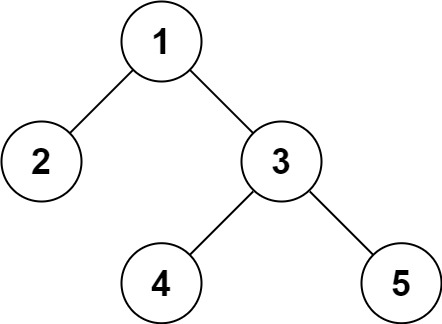
Serialized string might be: "1,2,null,null,3,4,null,null,5,null,null"
Solution Approach - Depth-First Traversal
Breaking Down the Solution
- Serialize Function: Convert the tree into a string representation using pre-order traversal.
- Deserialize Function: Reconstruct the tree from the string representation, again using pre-order traversal logic.
- Handling Null Nodes: 'null' is used to represent the absence of a node.
Conclusion
Serializing and deserializing a binary tree is a critical problem in tree algorithms, demonstrating the importance of tree traversal techniques and data representation in computing.
Rust Solution
Option<Box<TreeNode>> pushes the null-versus-node distinction into the type system, so the whole solution matches on None / Some(n) instead of a === null check, and Box heap-allocates each child to give the recursive struct a known size. The accumulator is threaded as &mut Vec<String> rather than returned, and build takes &mut std::vec::IntoIter<&str> — one owning cursor that each recursive call advances via iter.next(), replacing the TS arr.shift(). The or-pattern Some("null") | None => None folds the sentinel and end-of-input into a single arm, so there is no explicit empty-input branch like the TS throw; only the real value arm reaches s.parse().unwrap().
Go Solution
Go's *TreeNode pointer carries the nullability, so nil is the sentinel and the base cases read node == nil / return nil — Go returns nil rather than an empty struct. Because a function literal can't reference itself, both recursions use the forward-declaration trick var helper func(*TreeNode) before assigning the closure, letting helper and build recurse into themselves. strconv.Itoa and strconv.Atoi handle the int/string conversion, and since Atoi returns (int, error) the error is dropped with the blank identifier in v, _ := strconv.Atoi(...). Deserialize keeps a closed-over idx bumped with idx++ as a shared cursor into the strings.Split parts, instead of consuming the slice.
Comments (0)
Stub — comments live in your browser only (localStorage). No server round-trip yet.
No comments yet. Be the first.