Spiral Matrix: Traversing 2D Arrays in a Spiral Pattern
The "Spiral Matrix" problem involves traversing a 2D matrix in a spiral order, starting from the top-left corner and moving clockwise.
Problem Statement
Given a m x n matrix, return all elements of the matrix in spiral order.
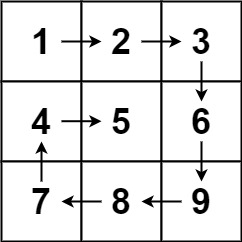
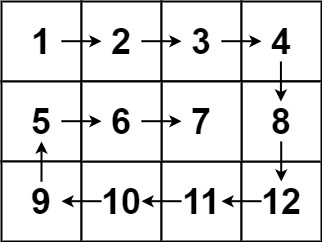
Example
- Input: Matrix
[
  [1, 2, 3],
  [4, 5, 6],
  [7, 8, 9]
]
- Output:
[1, 2, 3, 6, 9, 8, 7, 4, 5]
Solution Approach (typescript)
Breaking Down the Solution
- Initialize Boundaries: Start with boundaries (left, right, top, bottom) for the matrix.
- Traverse in Spiral: Move right across the top row, down the rightmost column, left across the bottom row, and up the leftmost column, adjusting boundaries each time.
- Continue Inward: Repeat the process for each layer of the spiral until all elements are covered.
Solution Approach (go)
In this Go solution:
- The function
spiralOrdertakes a 2D integer slice (matrix) and returns a slice with the elements in spiral order. - The variables
top,bottom,left, andrightdefine the boundaries of the current layer of the spiral. - The spiral traversal is performed by moving right, down, left, and up, adjusting the boundaries after each direction change.
- The loop continues until all elements are traversed, shrinking the spiral layer by layer.
#include <iostream>
#include <vector>

std::vector<int> spiralOrder(std::vector<std::vector<int>>& matrix) {
    std::vector<int> result;
    if (matrix.empty()) return result;

    int top = 0, bottom = matrix.size() - 1;
    int left = 0, right = matrix[0].size() - 1;

    while (left <= right && top <= bottom) {
        // Move right
        for (int i = left; i <= right; i++) {
            result.push_back(matrix[top][i]);
        }
        top++;

        // Move down
        for (int i = top; i <= bottom; i++) {
            result.push_back(matrix[i][right]);
        }
        right--;

        if (top <= bottom) {
            // Move left
            for (int i = right; i >= left; i--) {
                result.push_back(matrix[bottom][i]);
            }
            bottom--;
        }

        if (left <= right) {
            // Move up
            for (int i = bottom; i >= top; i--) {
                result.push_back(matrix[i][left]);
            }
            left++;
        }
    }

    return result;
}

int main() {
    std::vector<std::vector<int>> matrix = {
        {1, 2, 3},
        {4, 5, 6},
        {7, 8, 9}
    };

    std::vector<int> result = spiralOrder(matrix);
    for (int num : result) {
        std::cout << num << " ";
    }
    std::cout << std::endl;

    return 0;
}
In this C++ solution:
- The function
spiralOrdertakes a reference to a 2D vector (matrix) and returns a vector with the elements in spiral order. - The variables
top,bottom,left, andrightdefine the current spiral layer's boundaries. - The spiral traversal includes moving right, down, left, and up, with each direction bounded by the current layer's limits.
- The loop continues until all layers are traversed, reducing the spiral layer by layer.
Solution Approach (rust)
In this Rust solution:
- The
spiral_orderfunction takes a matrix (aVec<Vec<i32>>) and returns a vector containing the elements in spiral order. - The
top,bottom,left, andrightvariables define the boundaries of the current spiral layer. - The code performs spiral traversal, moving right, down, left, and up within the boundaries of the current layer. It decreases the layer size after each direction.
- The
saturating_subfunction is used to prevent underflow when decrementingbottom. - Rust's range syntax (
..=) and its ability to reverse ranges (rev()) are used to iterate over rows and columns.
Conclusion
The Spiral Matrix problem is a fascinating challenge that requires careful manipulation of array indices and boundaries. It is a popular question in technical interviews, testing understanding of 2D arrays and iterative traversals.
Comments (0)
Stub — comments live in your browser only (localStorage). No server round-trip yet.
No comments yet. Be the first.